
Health Inequalities in Grampian Trends
Health inequities can be measured through comparing the prevalence of health conditions and mortality, and behavioural risks to health such as smoking and drinking across different SIMD quintiles. The following section provides examples using a range of health related data to illustrate how differences in the levels of deprivation are associated with different health outcomes and use of health services.
Health inequities are the observable differences in people’s health across the population and between specific population groups. It is common for the term “health inequalities” to be used inter-changeably with “health inequities”.
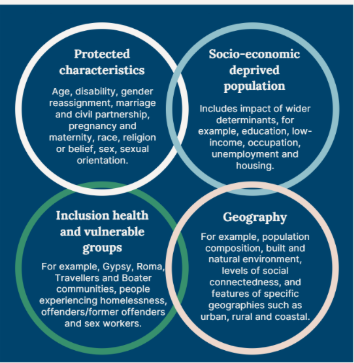
Health inequities can be experienced by people grouped by a range of different factors (see Figure 16 taken from NHS Grampian’s Health Equity 5 year plan). These factors often overlap, meaning people can fall into more than one category compounding the severity of health inequities experienced.
Figure 16: Groups at risk of health inequities (Source: Public Health England). Click on the image to enlarge.
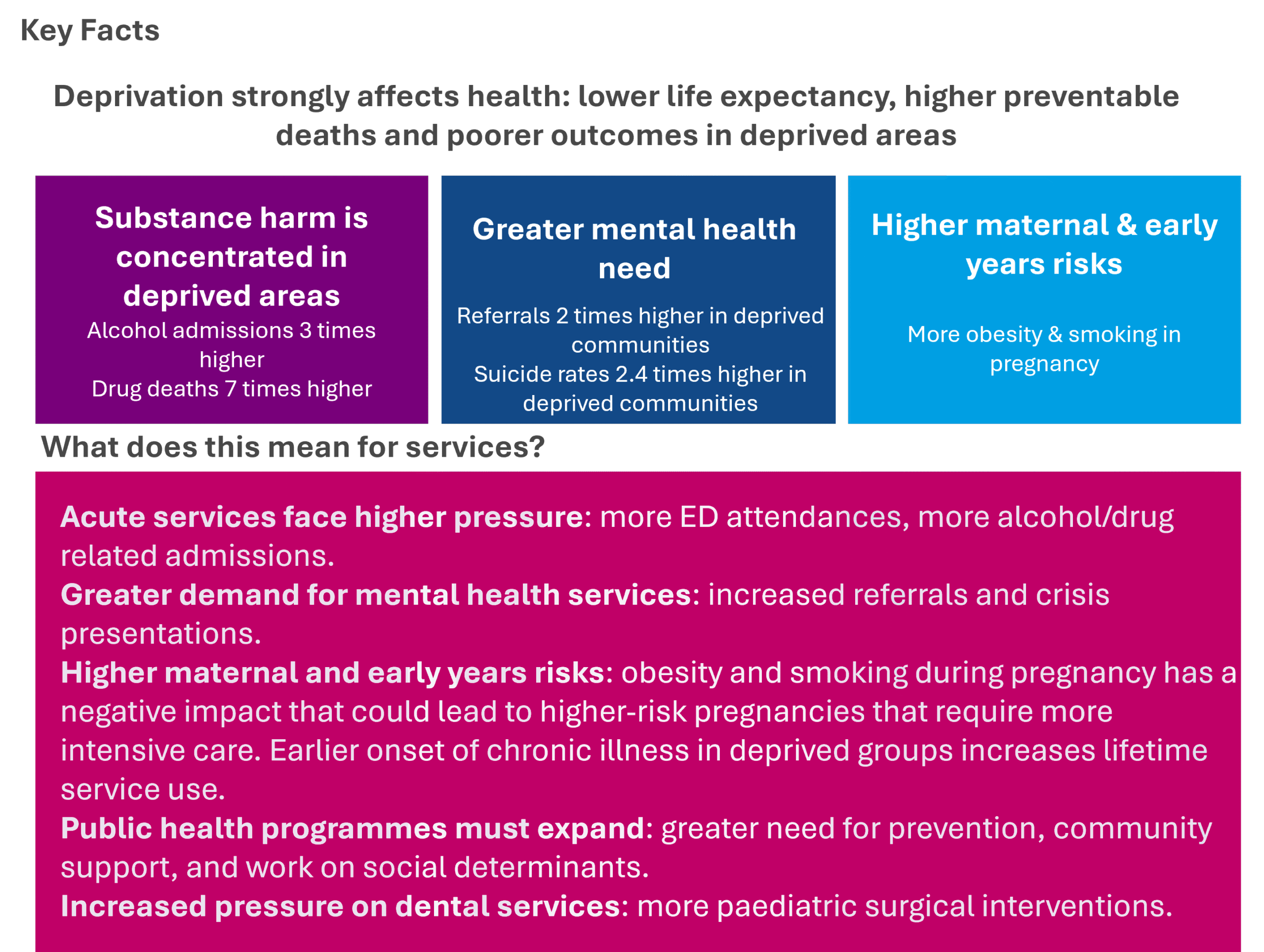
Health inequities can be seen and measured through the prevalence of health conditions and mortality, behavioural risks to health such as smoking, the wider determinants of health such as housing and employment, access to care and the quality and experience of using healthcare services.
Health inequality is a key determinant of the quality of life a child and adult may experience and can influence multiple aspects of an individual’s life which in turns determines how many years an individual will be live (Life Expectancy) and how many years this will live in good health (Healthy Life Expectancy).
Scottish Index of Multiple Deprivation (SIMD) is the Scottish Government’s standard approach to identifying areas of multiple deprivation across Scotland (Scottish Index of Multiple Deprivation). This measure looks “at the extent to which an area is deprived across seven domains: income, employment, education, health, access to services, crime and housing” (source Scottish Index of Multiple Deprivation).
SIMD helps better understand the circumstances of individuals and their health outcome. SIMD is an area-based measure of relative deprivation so does have some limitations and it is important to recognise that not every person in a highly deprived area will experience a high level of deprivation. Of particular relevance to Grampian, is the importance of considering SIMD alongside other data to give a more meaningful picture of for rural areas.
NHS Grampian has developed a 5-year Health Equity Plan which can be found at 5-Year Health Equity Plan (2024-2029). Additional webpages are currently being developed to support this plan and the work which is being done to support health equity across Grampian.
Back to Top
Back to Population Demographics
Next to Chronic Morbidity Overview
Back to Overview of Grampian’s population characteristics and health status