
Impact of Deprivation on Life Expectancy & Healthy Life Expectancy
The impact of wider health determinants such as deprivation on life expectancy is well recognised and core to the Health Equity work outlined in the NHS Grampian Plan which aims to reduce the gap between the most deprived and least deprived communities. Male life expectancy is considerably lower in the more deprived quintiles, as illustrated below in Figure 23.
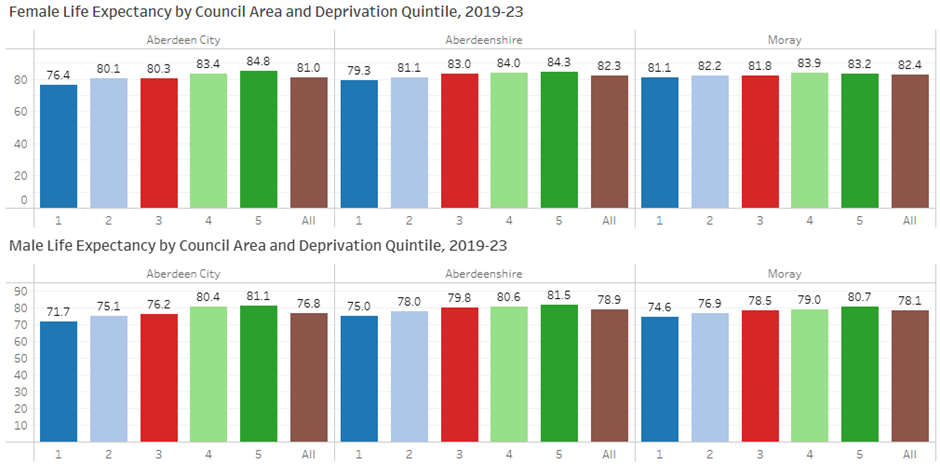
This is particularly noticeable in Aberdeen City. Figure 24 below shows that life expectancy, for the period 2019-23, was 9.4 years lower in the most deprived quintile than in the least deprived quintile. Similarly, female life expectancy is also lower in the most deprived quintile but the difference is less marked than with males. Closing these gaps requires tackling the social determinants of health: poverty, education, housing, and access to opportunity, alongside targeted service improvements.
Figure 23 – Male and Female Life Expectancy Trends by Local SIMD Quintile. Click on the image to enlarge.
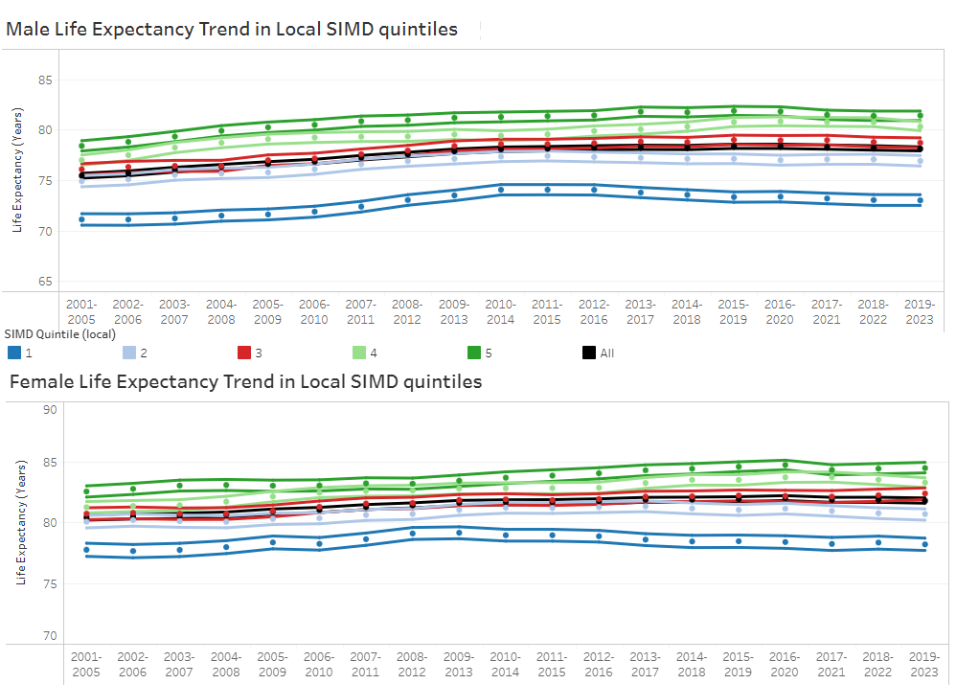
Figure 24 – Female & Male Life Expectancy by Council Area and Deprivation Quintile. Click on the image to enlarge.
Estimates of the impact of deprivation on Healthy life expectancy is currently under development by NRS which they plan to include in their next Healthy Life Expectancy publication (Healthy Life Expectancy, 2021-2023 – National Records of Scotland (NRS)).
As mentioned above, health inequities can be measured through comparing the prevalence of health conditions and mortality, and behavioural risks to health such as smoking and drinking across different SIMD quintiles. The following section provides examples using a range of health related data to illustrate how differences in the levels of deprivation are associated with different health outcomes and use of health services.
Next to Chronic Morbidity Overview