
What is causing the change in Grampian’s population demographics?
As outlined in the NRS Mid-2024 populations estimates publication (Mid-2024 population estimates – National Records of Scotland (NRS)) there are 2 main reasons why the population demographics change over time. The change is a combination of “natural change” (defined as the number of births minus the number of deaths) and “net migration” (defined as the number of people moving into an area minus the number of people leaving). Net migration can be due to migration within Scotland, rest of the UK migration and International migration.
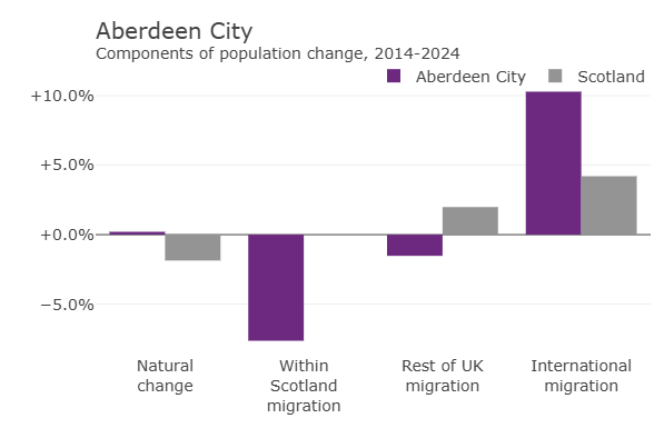
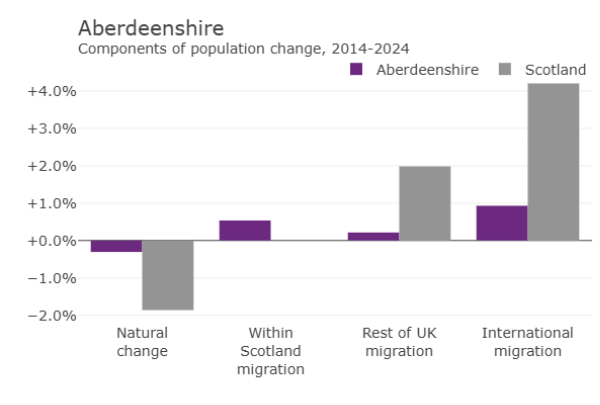
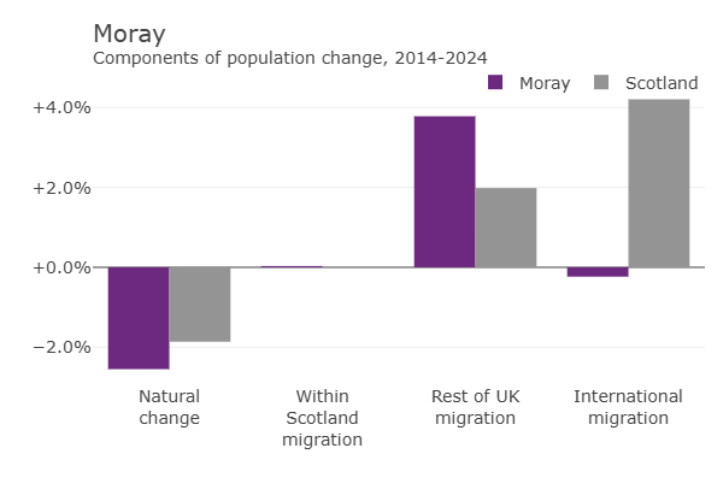
Natural change, within Scotland migration, rest of UK migration and International migration are the 4 main categories which are used by NRS to help understand the reasons for changes in population demographics across Scotland over time. Figure 20 summarises the underlying reasons for changes in population demographics from 2014-2024 for each local area. This figures shows a slightly different picture for each area with Aberdeen City population growth driven almost entirely by international migration. Aberdeenshire saw modest positive growth from international migration and within Scotland migration. Moray shows a very different profile, with a clear natural population decline but is dependent on inward movement from the rest of the UK as the main driver of its population stability.
Figure 20 – Underlying reasons for changes in the population demographics for local authorities (comparison with Scotland as a whole included). Click on the image to enlarge.
Source: Figure compiled using interactive data https://scotland.shinyapps.io/nrs-population-estimates/ available as part of the NRS mid-2024 population estimates publication.
Back to Ethnicity
Next to Projections
Back to Population Demographics