
Urban/Rural Split
It is recognised that living in an urban or rural area can have an impact on your health and wellbeing impact and life expectancy, as well as level of care and wider determinants of health such as poverty (Trends in Rural Scotland: a working paper (2025) – gov.scot). In the recent Trends in Rural Scotland paper, it highlights the following demonstrating the importance of consider urban and rural split across Grampian and local areas to inform service provision and reducing inequalities of care and health:
- Life expectancy is higher in rural Scotland than in urban areas for both male and females.
- Mental wellbeing also remains higher in rural areas despite general downward trends in Scotland.
- The experiences of those receiving care are better in remote rural areas than elsewhere in Scotland.
- Relative poverty and relative child poverty rates remain lower than those in urban areas.
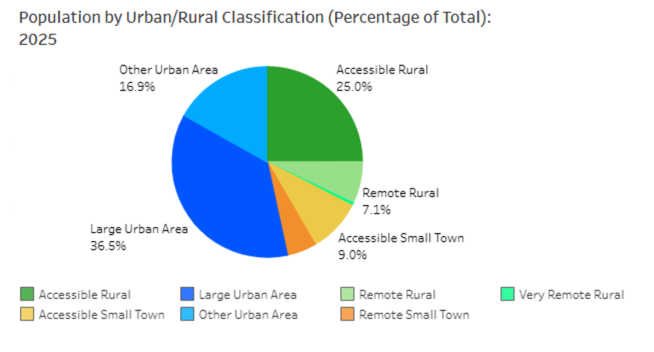
Over half (53.4%) of the population of Grampian live in an urban area, with almost a third (32.6%) living in rural settings, and a further 14% living in a small town (Figure 8). The rural population reflects the distinctive geography of Aberdeenshire and Moray. In Moray, 45.8% live in rural areas while in Aberdeenshire it is the majority (53.4%).
Rural areas present unique challenges accessing services such as health, transport, education, employment, and amenities. There is higher living costs associated with living in rural areas, and this can exacerbate poverty with the increased costs of fuel, food, and transport. This can have a detrimental impact on health outcomes and can add to health inequalities. Ensuring care is available close to home, supported by community transport, digital health innovation and flexible work models is key to achieving fair health outcomes across Grampian.
Figure 8. Population broken down by urban and rural classification. Click on the image to enlarge.
Back to Gender breakdown
Next to SIMD
Back to Population Demographics