
Life Expectancy
What does the stall in life expectancy and healthy life expectancy mean for the Grampian population?
The stall in life expectancy together with a decrease in health life expectancy means that more people are living longer lives with a larger proportion being in poor health. This results in a higher burden of disease and disability leading to increased dependency and care needs across our health and social care services. These changes highlight the need to focus on what can be done to improve the quality of life, and not just length of life.
Scotland
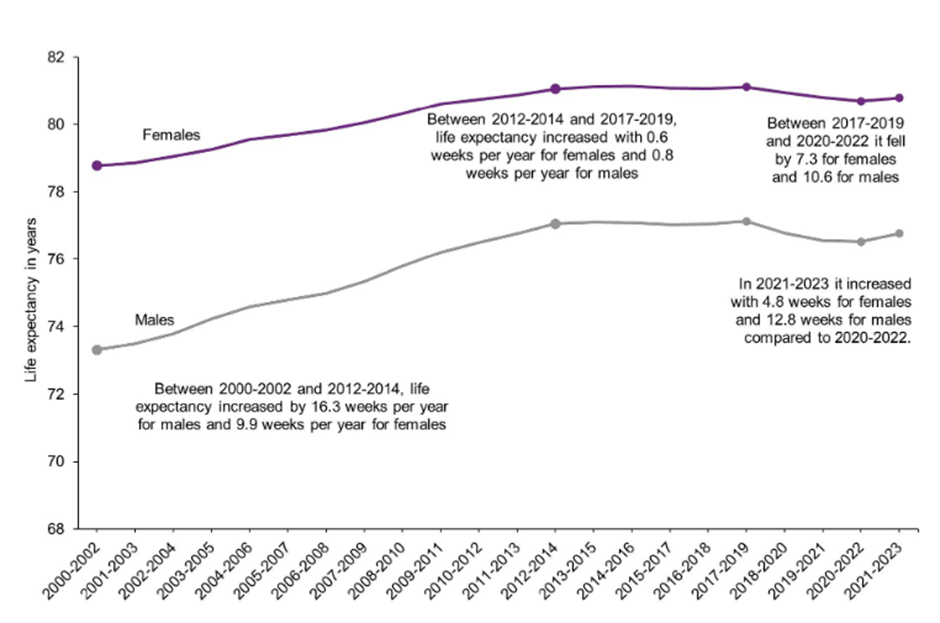
Life expectancy (LE) is an estimate of the number of years an individual is expected to live and is most often measured from birth. For the most part of the 20th century, life expectancy has increased year on year (with the exception of the impact of the world wars). The steady increase in life expectancy continued across the UK, and Scotland, until 2010. During 2008-2010, the improvement in life expectancy started to slow and, from 2012-2014 until 2017-2019, any improvement in life expectancy has stalled (Figure 31).
Scotland has the lowest life expectancy of Western Europe and, over the last decade, the gap has widened with other European countries (Life Expectancy in Scotland 2021-2023 – National Records of Scotland (NRS)). The gap in life expectancy between the most and least deprived in Scotland has continued to widen highlighting the importance of the impact of wider determinants on life quality. For males in 2021-2023 there was a 13.2 year difference between the most and least deprived deciles. For females the difference was less at 10.5 years.
Most recent figures (2021-2023) for Life Expectancy in Scotland show that it has increased to 80.8 years for females and to 76.8 years for males since 2020-2022 but remains below that of the pre-pandemic years (2021-2023).
Figure 31 – Life Expectancy in Scotland for males and females (2000-2023). Click on the image to make it bigger.
Grampian
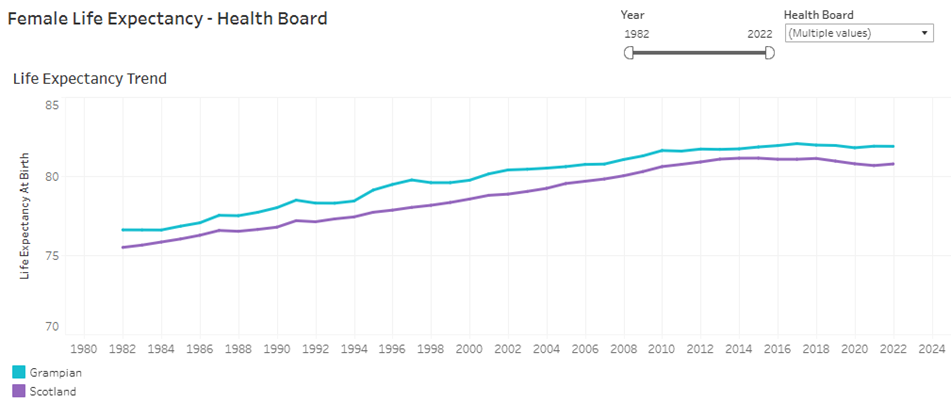
Generally, life expectancy in Grampian is higher than the Scottish average which is reassuring (Figure 32 & 33). Differences in age trends for males and females are seen at both a Scottish and Grampian level, with female life expectancy being higher than male life expectancy.
For the period 2021-23 male life expectancy in Grampian was 78.2 years compared to 76.8 years across Scotland. Female life expectancy was 81.9 years compared to 80.8 years across Scotland.
Whilst the male life expectancy in Grampian improved from 70.7 years in 1981-83 to peak at 78.5 years in 2017-19, it fell to just over 78 years in subsequent time periods and has remained fairly stable. Similarly, female life expectancy in Grampian improved from 76.6 years in 1981-83 to peak at 82.1 years in 2016-18 before falling to just below 82 years in subsequent time periods and has remain fairly stable.
Figure 32 – Male Life Expectancy trends for Scotland and Grampian. Click on the image to make it bigger.
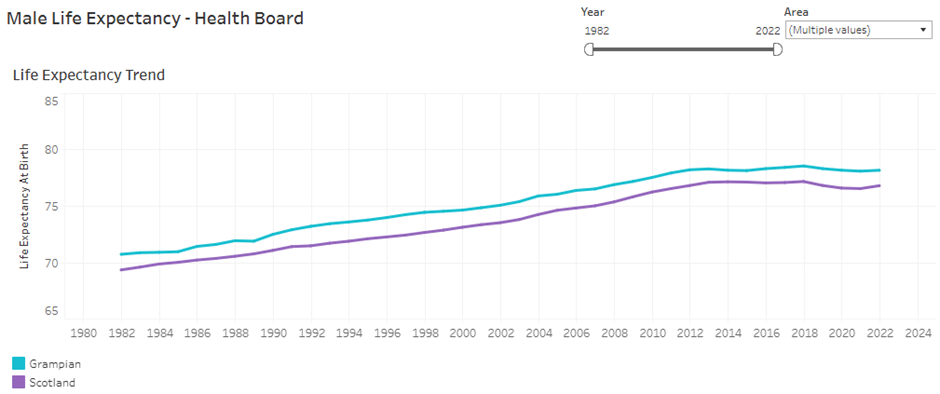
Figure 33 – Female life expectancy trends for Scotland and Grampian. Click on the image to make it bigger.
Council Areas
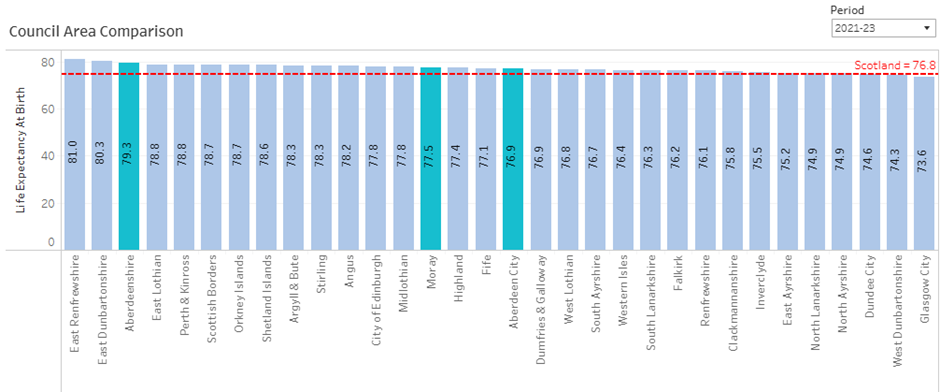
In Grampian, male life expectancy is highest in Aberdeenshire, at 79.3 years for 2021-23. This was the third highest life expectancy amongst Scottish council areas. Moray also has life expectancy above the Scottish average. Aberdeen City has lower life expectancy and the stalling began earlier than other areas with the peak occurring in 2009-11. Since 2004/5, the trend in Aberdeen City has been very similar to the Scottish average.
Figure 34 – Male Life Expectancy by area. Click on the image to make it bigger.
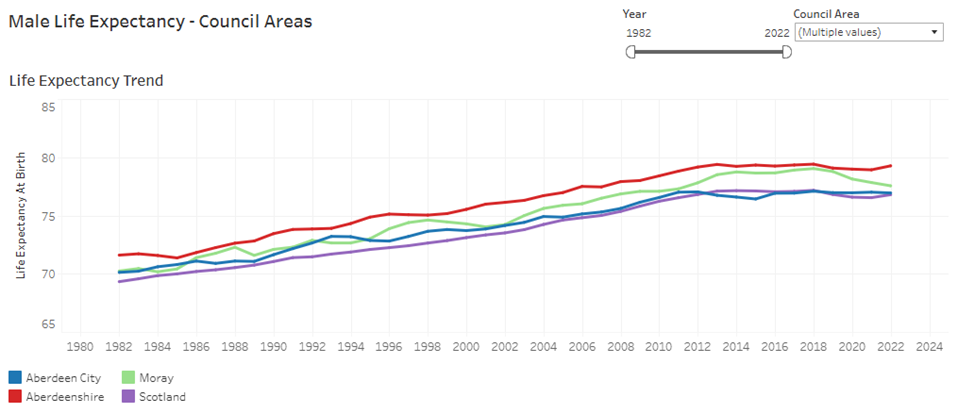
Figure 35 – Comparison of Male Life Expectancy by council area. Click on the image to make it bigger.
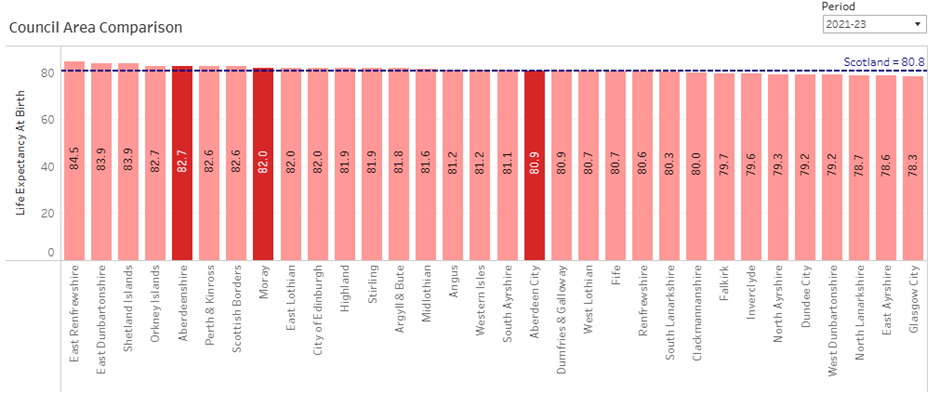
In Grampian, female life expectancy is also highest in Aberdeenshire, at 82.7 years for 2021-23. This was the fourth highest life expectancy amongst Scottish council areas. Moray also has life expectancy above the Scottish average. Aberdeen City has lower life expectancy and, as with males, the stalling began earlier than other areas. Since 2012, the trend in female life expectancy has been similar to the Scottish average
Figure 36 – Female Life Expectancy by area. Click on the image to make it bigger.
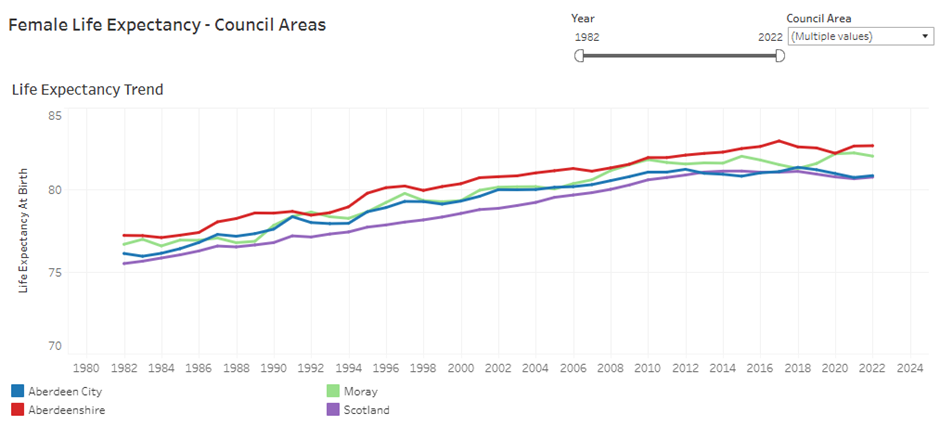
Figure 37 – Comparison of Female Life Expectancy by council area. Click on the image to make it bigger.
Back to Top
Back to Chronic Morbidity
Next to Healthy Life Expectancy
Back to Overview of Grampian’s population characteristics and health status